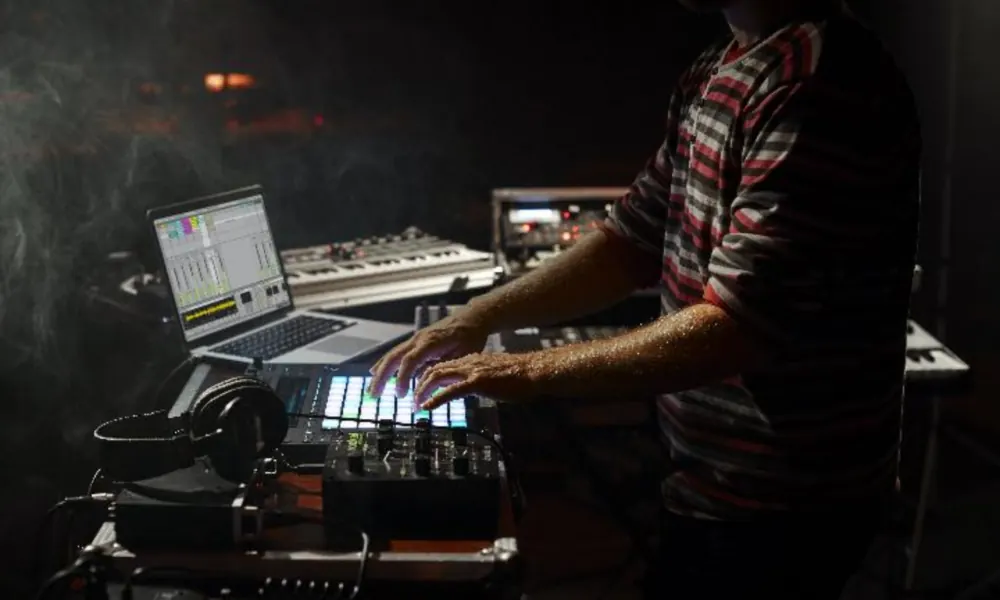
Electronic music performances have evolved into multi-dimensional experiences that blend performance software, controllers, lighting systems, video, and immersive sound. These components work together to create atmospheric shows that engage audiences far beyond what traditional DJ sets offered.
Performance Software and MIDI Control
Tools like Ableton Live have revolutionized how live sets sound and feel. Artists can launch clips, tweak effects, loop sounds, and rearrange tracks on the fly while performing, turning each set into a live composition rather than a simple playback of pre-recorded music.
MIDI controllers play a crucial role in this delivery. They allow performers to change software settings using physical controls, dials, or faders instead of staring at a laptop screen. DJs can plan much of this in advance, but the format allows room to play by ear and respond to the crowd in real time.
Controllers, mixers, and MIDI gear also enable DJs to create effects, loops, and layers while maintaining fine control over tracks. Audio can be divided into voices, drum parts, and instrument parts. Physical controls give sets a more organic feel, as artists can mix music on the fly instead of simply cueing it.
Lighting and Visual Design
Lighting has achieved equal status with sound in contemporary electronic shows. LED displays, projection mapping, programmers' rigs, and sound-triggered effects have become as responsible for ambience as the music itself. A visual component synchronized precisely to the music adds visual stimulation for the audience.
Many of these components are becoming more affordable, making it possible for lower-income artists and DJs to experiment with lighting rigs. Lighting design has emerged as a defining trend in modern electronic performances.
Spatial Audio and Audience Interaction
Spatial and immersive audio represents another major development in the live arena. Unlike normal stereo sound fields where sound emanates from a pair of fixed speakers, spatial soundscapes can place sound points at any location within the live audience, creating a real feeling of space and direction. Electronic music lends itself well to this approach, as producers already work with separate sounds rather than single live takes.
Cameras, sensors, and interactive systems are increasingly being used to incorporate audience movement into performances. Visual, sonic, or live elements can be directly driven by the crowd, altering the connection between artist and audience. Everyone in the crowd becomes a co-creator instead of just an observer.
As these technologies continue to improve, live shows are expected to become even more immersive and interactive. The music industry is following broader trends toward immersion and participation, with electronic music leading the way in performance innovation.

Community Signals
Login or Sign up to broadcast on this frequency.
> No signals detected on this frequency.