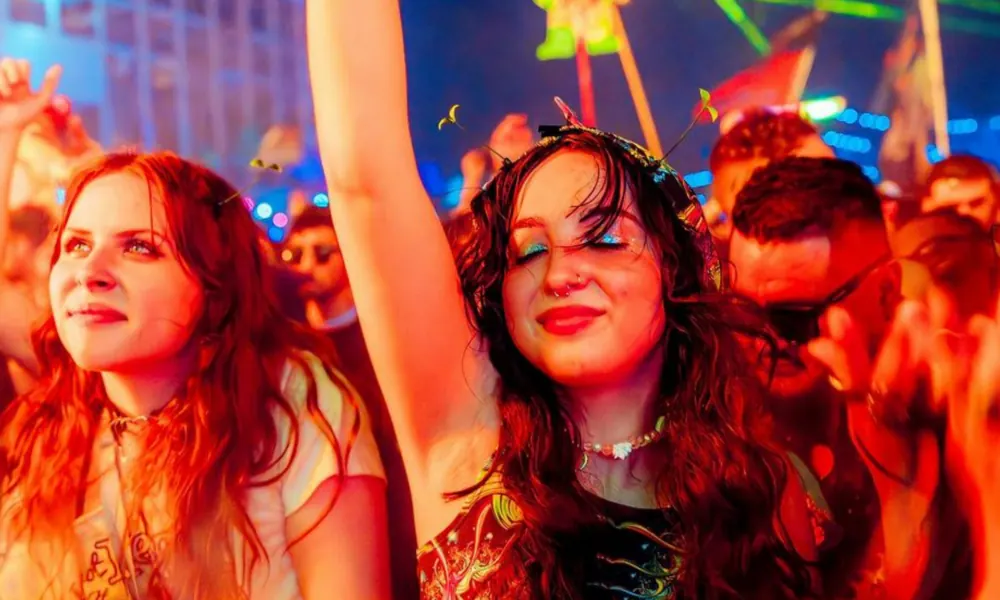
For many people, dancing at a festival or club is more than entertainment. Hours spent moving to familiar tracks alongside other people can leave dancers feeling calmer, more connected, or mentally lighter afterward. Those casual descriptions point to something researchers have increasingly been studying: the relationship between music, movement, and emotional regulation.
Embodied Pleasure and Social Connection on the Dancefloor
A 2025 study involving 612 dance music event attendees found that a stronger desire to dance was associated with greater embodied pleasure, which was closely linked with emotional synchrony and social connection. The findings offer a scientific basis for examining why dancing to EDM can feel therapeutic, and where the comparison between raving and therapy actually holds up.
In a dance music setting, the significance may lie in how little conscious effort movement requires once someone is fully engaged with the music. Instead of deliberately trying to regulate an emotion, attention can shift toward the beat, the physical repetition, and what is happening in the present moment, which may temporarily reduce the amount of focus given to stress or intrusive thoughts. That could help explain why people often describe long periods of dancing as mentally clearing or releasing, even when they struggle to explain exactly why afterward.
Movement, Music, and Trauma Recovery
A 2026 study published in Psychological Trauma examined a conscious dance and expressive arts intervention called Rhythms of Resilience among adults with complex trauma histories. The program combined mindful movement to music with expressive arts across six weekly group sessions. Half of the participants who completed the program reported clinically significant reductions in post-traumatic symptoms, while the group also showed increases in compassion and social engagement.
The study did not find measurable changes in emotion regulation itself, which limits how far the findings can be taken. What it does suggest is that structured movement to music may support some of the psychological and social processes linked with recovery, particularly when movement is combined with reflection and group participation. That makes it relevant to the discussion around dancing to EDM, where repeated movement, music, and shared participation are already central parts of the experience.
When Performance Becomes Collective Release
Dancing can take on a different role when the music connects with something an artist or audience is already trying to work through. Skrillex's five-hour Red Rocks show in 2023 took place after he had spoken openly about the death of his mother, depression, and problems with alcohol during a difficult period in his life. With no special guests and five hours spanning different parts of his career, the night gave Skrillex and the crowd hours to dance, sing, and react together, while he later described it as one of the best nights of his life.
A different kind of return came with Hardwell at Ultra Music Festival in 2022, four years after he stepped away from an intense touring schedule and later spoke about the importance of taking time away when an artist begins to feel burnt out. His return to Ultra placed him in front of a major festival crowd again with an entirely new body of music. He admitted that he had no idea how the audience would respond to a set consisting entirely of unreleased material, making their reaction particularly meaningful after several years away from touring.
During Defqon.1's Power Hour in 2023, around 65,000 attendees jumped from side to side together during its well-known Left-Right crowd movement, turning thousands of separate reactions to the music into one coordinated action across the festival. At ODESZA's final The Last Goodbye tour shows at The Gorge in 2024, dancing was accompanied by years of memories connected to the music, with the ECHOES installation featuring emotional voice messages from attendees about what ODESZA had meant to them.
The effect is likely to vary from person to person, since music preference, comfort in the setting, and personal associations with certain tracks can all influence how someone responds. In that sense, the therapeutic feeling may come less from EDM itself and more from what sustained movement to personally meaningful music allows the mind and body to do for a period of time.

Community Signals
Login or Sign up to broadcast on this frequency.
> No signals detected on this frequency.